R&D funding for neglected diseases remained stable at $4.3bn in 2024
By Dr Paul Barnsley 5 February 2026
Rising multi-disease R&D offset another decline in neglected disease-specific R&D
Overall funding for neglected disease R&D is now $656m below its peak
For more details on how funding for global health R&D changed in 2024, see our report, ‘Funding for global health R&D in 2024’.
Impact Global Health’s latest G-FINDER survey of global health R&D showed a significant decline in funding directed specifically to neglected disease, which was almost entirely offset by further rises in neglected disease-relevant multi-disease funding (‘crossover funding’).
While overall funding for R&D relevant to neglected disease was almost entirely unchanged at $4.3bn (up by just $7.7m, or 0.2%), this reflected the combined effects of a further shift away from ND-specific R&D, which sagged by a further $93m (or 2.4%) and yet another increase in crossover spending, which has more than tripled since 2018, mostly thanks to big COVID-driven increases in multi-EID projects with potential applications to neglected disease.
Neglected disease R&D and crossover multi-disease funding, 2018-2024
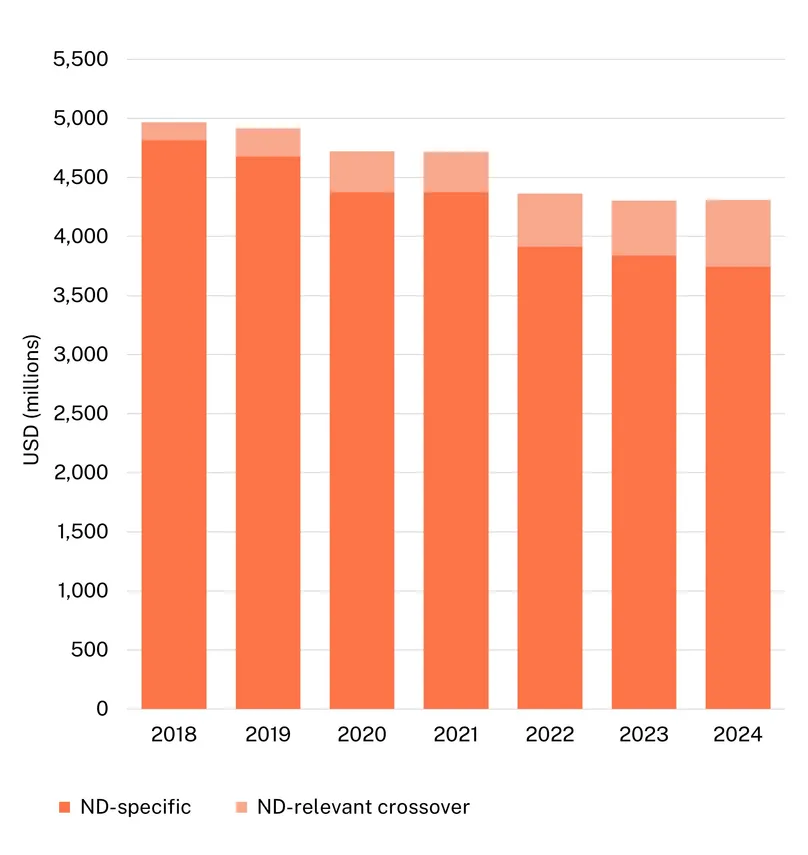
Even taking into account the rise in crossover funding, overall ND R&D has been gradually declining from its 2018 peak, falling every year until 2024 – by a total of $656m, or 13%.
Areas with the largest absolute change in 2024
-808x683.webp)
A little over half the roughly $100m 2024 fall in ND-specific R&D was due to a slight reduction in funding from the US NIH (down by $54m, -3%), which has now fallen for five straight years. This, in turn, was due to another big reduction in the NIH’s HIV funding, which fell by a further $62m (-6%) and which is nearly $300m below its peak in 2019. Further reductions in NIH spending are believed to have occurred in 2025, as a result of wider cuts to US government research funding.
This 2024 reduction in NIH funding, along with a smaller drop from the Gates Foundation, saw overall funding for HIV fall sharply for a third consecutive year (down by $93m, or 7%, after falling by more than $150m in 2023). There were cuts to every product area, with the largest reductions falling on HIV basic research (down $37m, -17%) and biologics (down $14m, -19%).
Tuberculosis funding, on the other hand, repeated last year’s steady growth. It rose by a further $41m (5%) in 2024, thanks to another big increase in Gates Foundation funding for late-stage trials of the M72 vaccine candidate.
The Foundation’s TB R&D funding more than doubled from $137m in 2021 to $281m in 2024 – an increase of $145m, of which just over half has gone towards increased funding to the Gates Medical Research Institute (MRI) for late-stage trials of M72. Gates TB vaccine funding to the MRI reached a record $108m in 2024, up by more than $40m (67%) from 2023 – a fifth consecutive year of growth, with further increases expected in 2025.
Areas with the largest proportional change in 2024
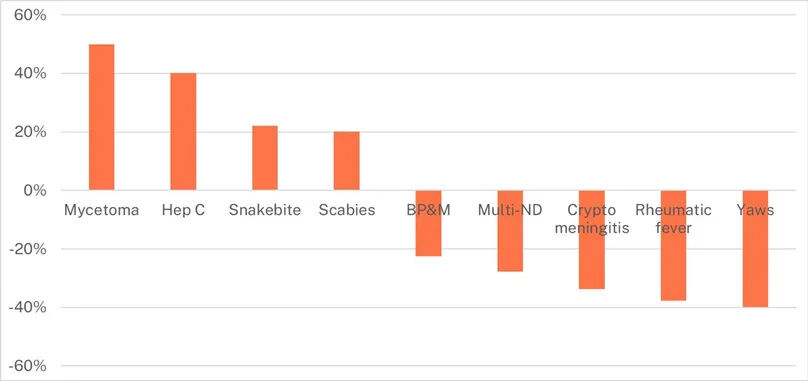
Among the smaller neglected diseases, funding fell further for bacterial pneumonia & meningitis (‘BP&M’, down by $5.1m or -22%, continuing a longer-term decline), as did funding for rheumatic fever, cryptococcal meningitis and Yaws. By contrast, hepatitis C funding rose by 40% ($8.5m), driven by a $5.1m (30%) increase in its NIH funding, which is now up by nearly $18m (400%) since 2020, combined with the ramp up of a new 2023 funding stream from Coefficient Giving (formerly Open Philanthropy – up $2.4m to $2.8m). Diarrhoeal diseases R&D rebounded slightly, rising by $5.6m (4%), thanks to a rebound in industry funding from last year's record low and a big new stream of funding ($7.9) from Coefficient Giving, primarily focused on the development of a novel cholera vaccine.
Funding to PDPs specifically for neglected disease R&D finally rebounded slightly in 2024, growing by $12m (4%) from last year’s record low of $301m, which returned it to roughly its 2022 level –still nearly half a billion dollars below its 2008 peak. A $23m (55%) rebound in funding from the UK FCDO, an additional $6m from the Dutch DGIS and a (short-lived) $7m from USAID were enough to offset further steep cuts from the Gates Foundation (down around $33m, or 23%) and a smaller reduction from the NIH (down $4.4m, -21%) – which took both organisation’s PDP funding to record lows.
Overall funding for the WHO neglected tropical diseases (NTDs) included in the G-FINDER survey was basically unchanged at $419m (up just $5.7m, or 1%), leaving it broadly in line with its average level over the last decade. Dengue R&D funding fell a little from last year’s record high, while funding for helminths and snakebite rose – the latter growing by 22% to a record $39m.
The net results of all these shifts are a funding landscape that still looks very much like it did in 2023: an ongoing retreat from HIV R&D, big bets on the M72 TB vaccine, several diseases receiving almost no R&D funding, and an increasing reliance on potential spillovers from R&D primarily aimed at combatting EIDs. Given the subsequent impact of US spending cuts in 2025 – which our recent report estimated at more than $800m across all areas of global health R&D – the overall direction of travel is not promising.