Product Pipeline Portal User Guide
By Impact Global Health 23 August 2026
What it is, who it's for and how to get started
This guide introduces the Product Pipeline Portal — what it is, who it's built for, and how to start using it to explore the global health product development landscape. It also answers the frequently asked questions about the data provided on the portal. Use table of contents on the right-hand side to jump straight to the section you need or scan below for a quick overview.
What is the Product Pipeline Portal?
The product pipeline portal is a free, open-access repository of health products approved or in development across neglected diseases, emerging infectious diseases and women’s health. Our data collection began in 2019, expanded in 2021 and has been updated annually since 2023. As the portal’s scope has grown over time, some products are only tracked from a later date.
The portal is an interactive tool which enables users to extract and analyse the approved products or candidates to build a deeper understanding of the development landscape. Filters, graphs and tables allow users to move easily from a broad overview per global health area to a detailed analysis of individual products and their specificities such as their technology type and mechanism of action.
Who is it for?
The product pipeline portal is a valuable tool for those seeking to understand the product development landscape for a particular global health area, product type, disease or condition. Examples include:
- Funders wishing to identify diseases or product types that are underfunded relative to burden, spot gaps in the pipeline, and use trend data to justify or redirect funding decisions.
- Policymakers and advocates who want to identify where advocacy efforts are needed most.
- Product developers seeking to understand the competitive landscape, identify complementary products or spot underserved niches before committing resources.
- Government and health care professionals looking to anticipate what products may come to market in the future.
- Researchers and academics needing a thorough and existing database to analyse the product development landscape.
- Journalists who need to quickly understand the development context for a specific disease area or approval announcement without interpreting raw datasets themselves.
- Patients interested in tracking candidates that target their health concerns.
- Clinical trial providers who want to build the case for local investment, capacity and partnerships within regions or countries.
- Anyone interested in the product development process and wishing to understand the current landscape
Why did we build it?
The product pipeline portal is a unique dataset for the global health community. Without a centralised repository, it was difficult to see the full picture of the product development landscape: which health issues had robust or depleted pipelines, which tools were nearing approval, and how closely current pipelines aligned with WHO's product-development priorities.
This portal brings those insights together in one place, helping the community make informed decisions and track our collective progress toward getting approved products for these health challenges.
How to get started
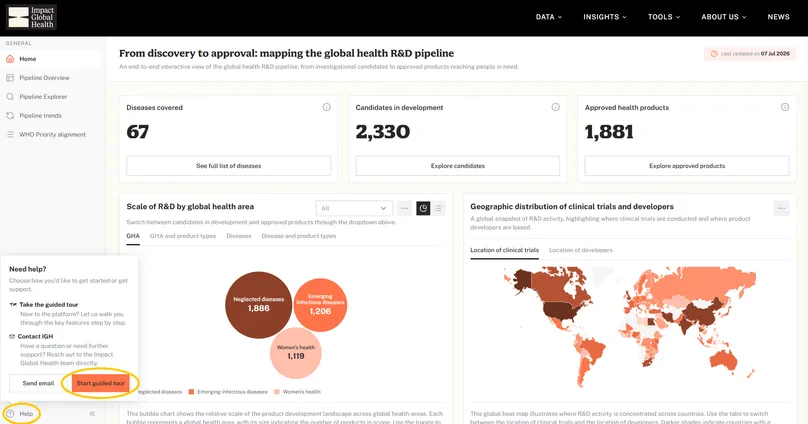
Take the guided tour for an overview of the portal’s key features.
Where does the data come from?
Products and candidates are sourced from clinical trial registries (ClinicalTrials.gov and the World Health Organization International Clinical Trials Registry Platform), a major biomedical literature database and organisations’ published product development portfolios. A specialist diagnostics test directory supplies the diagnostics pipeline, which the trial registries cover poorly.
Regulatory and prequalification listings are from the World Health Organization prequalification and emergency use listings, the US Food and Drug Administration and the European Medicines Agency.
Which diseases and products are covered?
The pipeline covers three global health areas: neglected diseases, emerging infectious diseases and women's health. Each area has a defined set of diseases or conditions, and each disease has a defined set of product types tracked for it.
Eight product types appear across the pipeline: drugs, vaccines, biologics, diagnostics, microbicides, vector control products, dietary supplements and devices. Not every one applies to every disease.
We will soon provide annexes to detail our methodology.
How often is the data updated?
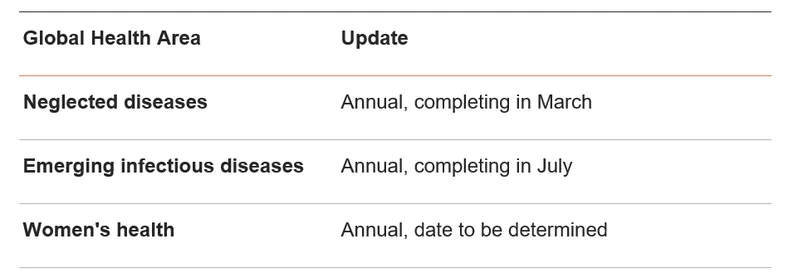
The data is updated annually:
What time period does the data cover, and why does it vary by product?
Our data collection began in 2019, expanded in 2021 and has been updated annually since 2023. As the portal’s scope has grown over time, some products are only tracked from a later date. For more information, see our methodology page.
Is the product pipeline portal’s scope the same as for the G-FINDER funding survey and portal?
Yes, the scope of the data on the G-FINDER funding portal and the Product Pipeline Portal are the same.
Does the portal show discontinued or abandoned candidates?
We do not have a filter to show discontinued candidates, however, this can be uncovered by downloading the products across all relevant years and seeing which ones disappear in subsequent years.
Can I add a candidate or product to this repository?
We welcome input and users can contact us through the portal’s help section at the bottom of the left-hand menu. Please include the product name, the disease, the developer, and a public reference — a trial registration, publication, regulatory listing or organisational announcement — so the record can be verified against a source.
What can I do if I spot an error or missing product?
If a record is missing, wrong or out of date, tell us through the help section on the pipeline home page. A candidate absent from the pipeline, a developer or product name recorded incorrectly, a stage that has moved on, a product since approved or discontinued — all are worth reporting.
Please include the product name, the disease, the developer, and a public reference — a trial registration, publication, regulatory listing or organisational announcement — so the record can be verified against a source. Corrections are assessed against the same scope rules and review process as any other record.
Is the portal free to use?
Yes, the portal is free to use.
How should I cite the portal or its data in my own reports?
Please use: Impact Global Health. “Product Pipeline Portal” [online database]. Retrieved [Day Month Year] from pipeline.impactglobalhealth.org
Who can I contact if I have a question or feedback?
Please email us via the help section on the pipeline home page.
Table of contents
- What it is, who it's for and how to get started
- What is the Product Pipeline Portal?
- Who is it for?
- Why did we build it?
- How to get started
- Where does the data come from?
- Which diseases and products are covered?
- How often is the data updated?
- What time period does the data cover, and why does it vary by product?
- Is the product pipeline portal’s scope the same as for the G-FINDER funding survey and portal?
- Does the portal show discontinued or abandoned candidates?
- Can I add a candidate or product to this repository?
- What can I do if I spot an error or missing product?
- Is the portal free to use?
- How should I cite the portal or its data in my own reports?
- Who can I contact if I have a question or feedback?