G-FINDER R&D funding portal user guide
By Impact Global Health 9 November 2026
What it is, who it's for and how to get started
This guide introduces IGH’s G-FINDER R&D funding portal — what it is, who it is built for, and how to start using it to explore the global health R&D funding landscape. It also answers frequently asked questions about the data provided on the portal. Use the table of contents on the right-hand side to jump straight to the section you need or scan below for a quick overview.
What is the funding portal?
The G-FINDER R&D funding portal is a free, open-access repository of R&D funding data across neglected diseases, emerging infectious diseases and women’s health. Our annual data collection began with neglected diseases in 2008 (capturing FY2007 data) and has expanded in scope since.
The portal is an interactive tool which enables users to extract and analyse annual investment into R&D for new products and technologies to address priority global health challenges. Filters, graphs and tables allow users to move easily from a broad overview per global health area to a detailed analysis of individual diseases and conditions and their products and R&D stages.
Who is it for?
The G-FINDER R&D funding portal is a valuable tool for those seeking to understand the R&D funding landscape for a particular disease or condition, funder, product type or recipient. Examples include:
- Funders wishing to identify diseases or product types that are underfunded relative to burden, and use trend data to justify or redirect funding decisions.
- Policymakers and advocates who want to identify where advocacy efforts are needed most.
- Product developers seeking to understand the funding landscape, identify complementary products or spot underserved niches before committing resources.
- Researchers and academics needing a thorough and extensive database to analyse the R&D funding landscape and identify potential sources of funding.
- Journalists who need to quickly understand the context for a specific disease area or funder profile without interpreting raw datasets themselves.
- Clinical trial providers who want to build the case for local investment, capacity and partnerships within regions or countries or with funders.
- Anyone interested in the global health R&D funding landscape and wishing to understand it better.
Furthermore, G-FINDER is the sole source of granular neglected disease R&D funding data for the WHO Global Observatory on Health R&D and is used as an indicator for the WHO Global Strategy and Plan of Action on Public Health, Innovation and Intellectual Property.
Why did we build it?
The G-FINDER R&D funding portal is a unique dataset for the global health community. Without a centralised repository, it was difficult to see the full picture of the R&D funding landscape. Our database allows users access to the long-term landscape of R&D funding for global health priority areas, identifying where funding gaps exist and demonstrating how investments fit into the global picture.
How to get started
Select a quick filter on the portal landing page, or select “Explore the data” to access an overview of all data that can be further refined by using the filters in the left-hand panel. Additional filters can be added in that same panel, and the Visualisations panel (also on the left-hand side) allows you to add additional visualisations to the centre page.
Where does the data come from?
The basis of the G-FINDER funding data is an annual survey of the world's key public, private and philanthropic organisations involved in global health R&D. An overview of all participants over time can be found here:
Organisations participating in the G-FINDER surveyNew invitees are continually identified through research conducted by Impact Global Health, and validated by relevant sector experts. Although the primary focus is on funders, we also survey key research, intermediary and industry groups to allow us to better track funding flows. The G-FINDER survey is sent to more than 900 organisations in approximately 60 countries. If you would like to participate in the survey, please email us at g-finder@impactgh.org.
Which diseases and products are covered?
The G-FINDER R&D funding portal covers three global health areas: neglected diseases, emerging infectious diseases and women's health conditions. Each area has a defined set of diseases or conditions, and each disease has a defined set of product types tracked for it. Nine product types appear across the funding data, in addition to basic research: drugs, vaccines, biologics, diagnostics, microbicides, vector control products, platform technologies, dietary supplements, and devices & combinations. Not every product applies to every disease, please refer to the full scope documents for neglected diseases, emerging infectious diseases and women's health.
As the scope expanded over time, not all diseases, conditions and products have been tracked across all years. This Excel file provides an overview of all neglected diseases, emerging infectious diseases, and women's health conditions as they were included in each year of the G-FINDER project, broken down to product level. It allows users of the data to assess the effects of changes in scope on R&D funding trends for individual health and product areas.
Download the G-FINDER scope historyFinally, not all funding for biomedical R&D is included in the scope of the G-FINDER survey: some health issue/product type combinations are excluded on the basis that they are likely to be commercially motivated and/or tailored to high income countries' needs, while some combinations are included only with restrictions. In-kind contributions are also excluded, due to the difficulty of accurately quantifying them and determining the share applicable to diseases or health issues within the scope of the G-FINDER data. Finally, the G-FINDER project only captures funding that has already been disbursed to the recipient, it does not include any data on undisbursed funding commitments.
How does the definition of NDs differ from the WHO list of NTDs?
The scope of neglected diseases captured in the G-FINDER R&D funding portal overlaps to a large extend with the list of neglected tropical diseases (NTDs) published by the World Health Organization. This document sets out a comparison of the two.
How often is the data updated?
A new financial year is added to the portal annually at the end of November. Intermediate refreshes may take place if new data comes in, errors are corrected, or new functionality is introduced.
What time period does the data cover, and why does it vary by global health area?
The G-FINDER project started tracking funding data for neglected diseases in 2008 (collecting FY2007 data), emerging infectious diseases in 2015 (collecting FY2014 data), and womens health conditions in 2019 (collecting FY2018 data), covering the spectrum from basic research to post-registration studies of new products.
Which currencies can I view the funding in?
Although the default currency is US dollars (USD), you can select any of the following to change your view: Euro (EUR), Pound Sterling (GBP), Brazilian Real (BRL), Australian Dollar (AUD), Canadian Dollar (CAD), Indian Rupee (INR), Japanese Yen (JPY), South African Rand (ZAR). By switching from Real to Nominal, you will view the values in USD that are unadjusted for CPI.
What is the difference between the direct and indirect views?
The majority of global health R&D funding goes straight from funder organisations to product developers. However, a significant portion of investments flows from funder organisations to product developers via product development partnerships (PDPs) and other intermediary organisations. We call funding from funder organisations to intermediary organisations 'inward' funding, and that of intermediary organisations to product developers 'onward' funding.
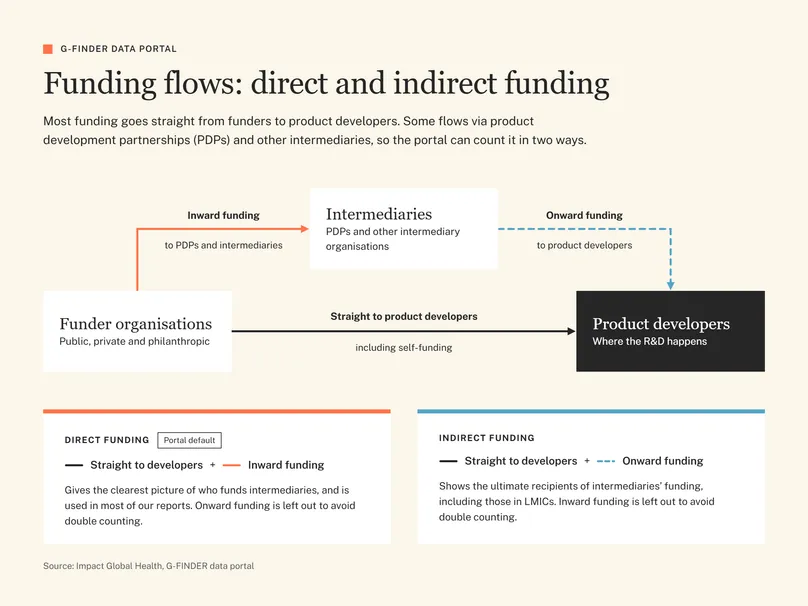
The default setting in the G-FINDER R&D funding portal is to display funding going straight to product developers (including self-funding) in addition to inward funding to PDPs and other intermediaries, referred to as DIRECT funding. This is also the default analysis used in the majority of our reports. When selecting direct funding in the portal, funding totals include contributions provided to PDPs and other intermediaries by their funders, but does not include grants where an intermediary organisation is the funder, since all onward funding is excluded to avoid double counting the value of funders' original contributions.
In mid-2022 we added the option to view the alternative flow of funding: keeping the funding going straight to product developers (including self-funding), but substituting the inward funding to PDPs and other intermediaries for the onward funding they provide to product developers. We call this the INDIRECT funding view. When INDIRECT funding is selected, funding totals include the payments to product developers disbursed by PDPs and other intermediary organisations, but not any funds given to these intermediaries, since including both flows would result in double counting.
As a result, direct and indirect funding figures relate to different measures of global funding and differ substantially. Note that some intermediaries report limited or no onward funding to the G-FINDER survey, causing us to underestimate the true levels of indirect funding. We hope to fill those gaps in the coming years.
How do I replicate funding for the 100DM scorecard?
Since 2023, IGH, in collaboration with the International Pandemic Preparedness Secretariat (IPPS), has curated the annual 100 Days Mission (100DM) Scorecard (SC). The 100DM SC is a visual tool that evaluates readiness to develop and deploy critical diagnostics, therapeutics and vaccines (DTVs) within 100 days of a public health emergency of international concern (PHEIC) - covering infectious diseases of epidemic potential. It identifies gaps, tracks progress, and provides actionable insights based on public data that supports R&D decision making through a series of evidence-based indicators. This document explains how the 100DM SC utilises G-FINDER funding data and how to replicate it.
On the G-FINDER R&D funding portal, you can also find a “100 Days Mission Scorecard diseases” group at the bottom of the Disease filter, which will automatically select the relevant diseases. If you also wish to select the relevant products, it is easier to access the portal via the 100 Days Mission Scorecard option on the portal’s landing page.
Is the product pipeline portal’s scope the same as for the G-FINDER funding survey and portal?
Yes, the scope of the data on the G-FINDER funding portal and the Product Pipeline Portal are the same.
Can I add funding to this repository? What can I do if I spot an error?
We welcome input and users can contact us on g-finder@impactgh.org if you would like to be contacted for the next survey or would like to request updates to your funding data.
Is the portal free to use?
Yes, the G-FINDER R&D funding portal is free to use.
How do I share the funding data?
The data shown on the funding portal can be tailored and then shared externally via the orange “Share this view” option on the top right-hand corner. This creates a unique link to the data and filters as you have applied them.
How should I cite the portal or its data in my own reports?
Please use: Impact Global Health, G-FINDER R&D funding portal, https://gfinderdata.impactglobalhealth.org
Where can I find additional resources and information?
- A full Methodology document covers the scope of the funding data, G-FINDER survey methodology, data validation and standardisation and data limitations. This document also includes an overview of key methodology notes for the use of the portal data specifically, such as the aggregation of pharmaceutical industry funding, and the impact of annual changes in survey participation.
- A Glossary provides definitions of commonly used terms on the G-FINDER R&D funding portal. There is also a Country and region overview of all countries included in the portal, with their economic, income and geographical group allocations.
- For ease of interpretation, the funding portal uses shortened organisation names for funders and recipients of R&D funding. An overview of organisation names provides a list of all organisations as they appear in the G-FINDER R&D funding portal, alongside their full organisation name.
- Our Tutorials show users how to navigate the G-FINDER R&D funding portal, filter and explore the data, and download the insights.
Table of contents
- What it is, who it's for and how to get started
- What is the funding portal?
- Who is it for?
- Why did we build it?
- How to get started
- Where does the data come from?
- Which diseases and products are covered?
- How does the definition of NDs differ from the WHO list of NTDs?
- How often is the data updated?
- What time period does the data cover, and why does it vary by global health area?
- Which currencies can I view the funding in?
- What is the difference between the direct and indirect views?
- How do I replicate funding for the 100DM scorecard?
- Is the product pipeline portal’s scope the same as for the G-FINDER funding survey and portal?
- Can I add funding to this repository? What can I do if I spot an error?
- Is the portal free to use?
- How do I share the funding data?
- How should I cite the portal or its data in my own reports?
- Where can I find additional resources and information?