Compass has expanded: real-time R&D funding data now covers emerging infectious diseases and women's health
By Thomas Clifton 26 March 2026
As with many things, it started with COVID
Back in 2020, funding announcements for COVID-19 research were flooding in, so we did something we'd never done before: we tracked it all in real time. By the end of 2020, we had logged US$9.1 billion in commitments. A year later, in late 2021, we were able to compare this figure to the real investments captured by the G-FINDER survey and that total came out at just over half: $4.7 billion.
That gap taught us a lot. Announced funding isn't always new money. There is risk of double counting. A ten-year commitment to provide $300 million isn't really $300 million once inflation hits, or priorities change. Despite that, and more, it showed us the value of tracking funding in real time: it helps fill the gap of understanding while the full picture is still being assembled. Like a finger to the wind, it shows the direction of funding for global health R&D.
That is why we called our next real-time tracking project Compass.
The problem Compass solves
While G-FINDER remains the gold standard for tracking annual R&D investment into neglected diseases (NDs), emerging infectious diseases (EIDs) and women's health (WH) conditions, we have found its rigour the source of it most common criticism. That rigour takes time, which means the data isn't available until late the following year.
Compass is our answer to that delay. We draw on data from funders who publish their grants publicly - including UKRI, the Gates Foundation, Coefficient Giving, and funding to PDPs and other intermediaries - and present it without waiting for the annual G-FINDER survey cycle. Those investments will eventually be captured by the G-FINDER survey, but Compass gets it in front of you sooner
Expanding Compass gives better direction
Despite origins during COVID, Compass began by only covering investments in neglected disease R&D. Starting in 2026, we are excited to share that it now also extends to emerging infectious diseases and women's health.
This expansion matters. Funding for EIDs is notoriously spiky - money floods in during outbreaks and recedes between them. Having a real-time view of active commitments between G-FINDER cycles is critical for tracking preparedness.
Women's health R&D has historically been under-funded and under-tracked; a more current picture of who is investing, and in what, is an important step towards strengthening insights into this critical field.
How to read Compass funding
Unfortunately, we can’t predict the future. We’ve tried. We’re still trying.
What we can do is share what we know. Looking at women’s health R&D funding below, the orange bars show funding from organisations that publish their data publicly - Compass funders - covering both past disbursements and projected future spending from active grants. The blue that sits on top represents the remainder of total funding that we capture later through the G-FINDER survey. Together, they add up to a total that matches G-FINDER figures exactly (displayed in nominal USD).
Look at the past years' Compass funding and look at the total for those years: shifts in orange Compass funding have proven to be a good bellwether for future funding.
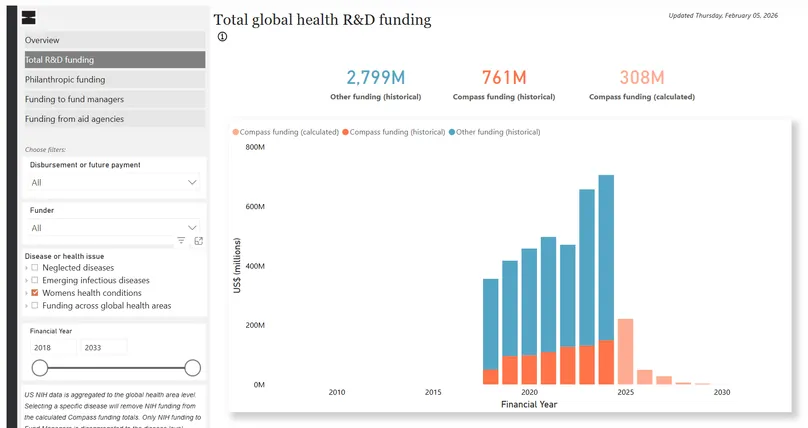
Looking towards the future, at first glance, it looks like funding falls off a cliff in 2026. It doesn't, it’s an artefact of timing. Writing this in March 2026, most of what Compass funders will announce for 2026 simply hasn't been made public yet. In a year's time, that picture will look much fuller. The narrow tail you see to the right is the result of prorating multi-year grants. Spreading their total value across remaining years naturally thins out at the edges of typical grant periods.
Think of Compass as a well-informed early view, not a final verdict.
Explore Compass
Compass is free and updated monthly. Whether you're a funder, researcher or advocate, we are excited to provide you a more current picture of the funding landscape than is available anywhere else.
For a more in-depth understanding, look to our Compass methodology and tutorial, or reach out! We're always keen to hear how you are using it, or how we can make it more useful. What questions are you trying to answer with funding data that you can't answer today? Get in touch with me at tclifton[@]impactgh[dot]org or info@impactgh.org.