Rotarix: preventing diarrhoeal disease across the globe
By Impact Global Health 18 June 2026
Context
Every breakthrough in global health sends ripples that reach far beyond borders. In an era of fiscal tightening and inward-facing policy priorities, investments in global health R&D are under increasing pressure. Yet these investments are among the most powerful drivers of innovation, economic growth, and resilience – not just for low- and middle-income countries (LMICs), but for high-income countries (HICs) as well. In the Ripple Effect project 1.0, Impact Global Health demonstrated that $71 billion in global health R&D funding from 2007 – 2023 catalysed $511 billion in GDP growth, 643,000 jobs, and 20,000 patents in HICs, a multiplier effect proving that global health investment drives domestic prosperity as well as global health outcomes. Building on this, the Ripple Effect 2.0 examined this dynamic through case studies of innovations initially developed for LMIC needs that later delivered measurable health and economic benefits in HICs. Now, the Ripple Effect 3.0 project extends this work by applying the same approach to five additional products, further strengthening the evidence base.
This case study focuses on the HIC benefits of the Rotarix rotavirus vaccine. It was developed by GlaxoSmithKline (GSK) following the side effects-driven withdrawal of the earlier RotaShield vaccine. GSK deliberately adopted a ‘South-first’ access strategy for Rotarix, using trials and distribution in Latin America to build the evidence base that led to its widespread adoption throughout the rich world.
- A vaccine which first targeted diarrhoeal disease in LMICs is now routinely administered by high income health systems. Rotarix sharply reduced the burden of rotavirus on children under two, their families and on the health system.
- By 2050, the adoption of Rotarix in the UK in 2013 will lead to more than 1.2 million fewer cases of diarrhoeal disease from rotavirus, prevent nearly 100 infant deaths and avert over 75 thousand DALYs.
- Along with savings to the health system worth well over half a billion dollars, Rotarix will deliver health gains valued at more than $22 billion in the UK alone.
- Wider adoption across the EU would deliver even larger benefits. EU-wide use would save over 1,000 lives and deliver total gains to society worth more than $130 billion.
What is rotavirus and how does Rotarix help reduce the burden of diarrhoeal disease?
Rotavirus is a virus that causes highly seasonal diarrhoeal disease, which imposes its heaviest burdens on the very young and the very old. Vaccination of young children against rotavirus with Rotarix starting at two months of age helps to prevent serious infections by boosting their immune response prior to their first exposure to the virus, while also providing protection to vulnerable elderly populations by reducing the amount of the disease circulating in the community and, especially, within the hospital system.
Innovation pathway
Rotarix is a live, oral, attenuated human rotavirus vaccine, based on the RIX4414 strain derived from human rotavirus strain 89–12 isolated in 1988 at Cincinnati Children’s Hospital in the US. It was developed to replace the earlier RotaShield vaccine, which was withdrawn from use in 1999 following ongoing concerns about its side effects on infants.
Its developer, GSK, deliberately conceived of Rotarix as a ‘South-first’ product, initially targeting middle-income nations like Mexico and Brazil where rotavirus mortality was much higher than in HICs. Here, they carried out some of the largest vaccine trials in history.
As well as improving on the side effect profile that had marred the global rollout of RotaShield, Rotarix offered key benefits for LMICs relative to its closest competitor, Rotateq. First, its two-dose schedule, rather than the three doses needed for Rotateq, greatly reduced the burden on both LMIC health systems and parents, achieving full protection sooner. Second, the experience provided by early LMIC trials made it easier to roll out in often logistically challenging LMIC environments, especially because of its ability to tolerate higher temperatures in transit.
Many of these advantages, it turns out, were also relevant to HIC health systems. Based on the data gathered in its Latin American trials, GSK applied for registration in HICs, leading to the widespread adoption of Rotarix as the standard infant vaccination for rotavirus.
Health impact in the EU and UK
We modelled the real-world impact of the UK’s adoption of Rotarix starting in 2013, and the counterfactual impact if the EU – where adoption remains limited to certain countries – had pursued universal adoption over the same timeline. These HIC markets were selected for this study for their substantial impact and good data availability.
Table 1: Potential health impact from Rotarix in the EU and UK
*For the purposes of this modelling exercise we considered the potential gains from EU-wide adoption of Rotarix on a similar timeline to that of the UK, rather than modelling the heterogeneous rollout dates across individual EU Member States.
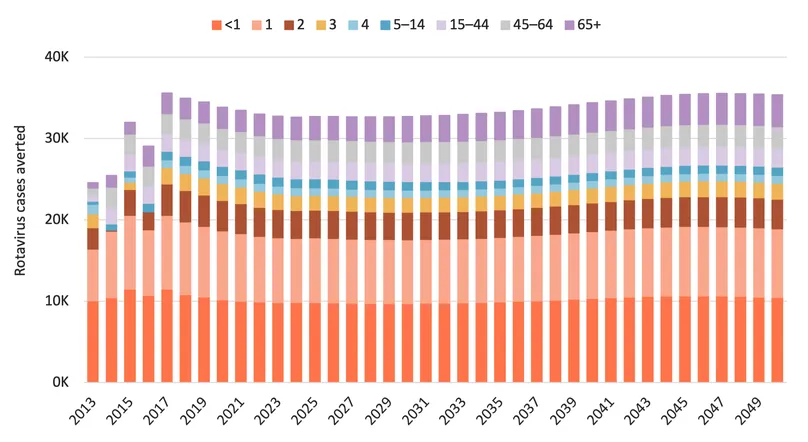
The number of deaths associated with rotavirus was small even prior to the adoption of Rotarix, with most of the benefit delivered in the form of averted infections. Early data from the UK following the rollout of Rotarix showed that case numbers fell sharply among the vaccinated cohort – by as much as 88% in children under one – but also among older, unvaccinated people, with over 65s experiencing a more than 40% drop in cases thanks to decreased community transmission.
Figure 1: UK rotavirus cases averted, by age group
Economic Impact in the EU and UK
Being alive and in good health has a value to the individual and to society. Using the Value of a Statistical Life approach, we estimated the societal gains from 568 thousand DALYs averted – discounted to reflect the slightly lower value associated with future years lived – to be just over $146bn[1] across our two markets: the UK’s actual rollout of Rotarix combined with the potential impact of widespread EU adoption on a similar timeline.
Avoiding infections also lowers the impact of rotavirus on the health system. We project a total of more than 2.6 million visits averted to general practitioners, emergency departments and hospitals by 2050 in the UK alone thanks to the adoption of Rotarix, and more than 32 million visits potentially averted across the EU.
Table 2: Value of potential impact from Rotarix in the EU and UK
*For the purposes of this modelling exercise we considered the potential gains from EU-wide adoption of Rotarix on a similar timeline to that of the UK, rather than modelling the heterogeneous rollout dates across individual EU Member States.
Figure 2: Value of averted healthcare visits in EU and UK
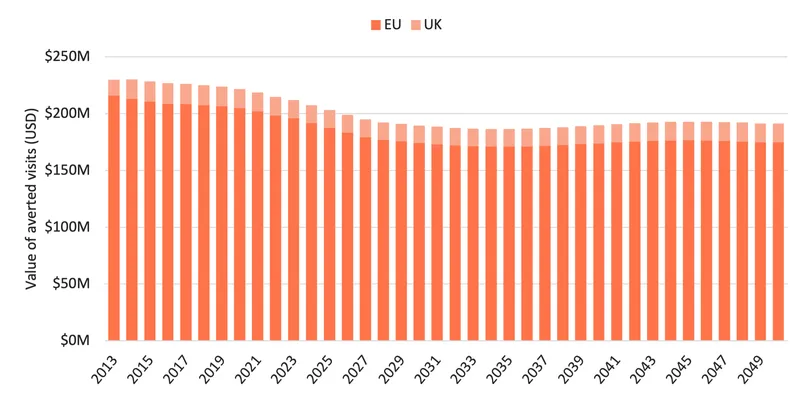
This chart shows the dollar value of these averted visits to the health system. Even ignoring the significant health impact and inconvenience rotavirus imposes to sick children and their families, rising projected health care costs mean that fewer cases will save health systems hundreds of millions of dollars – or billions across the EU.
[1] For ease of comparison, all monetary values are reported in inflation-adjusted 2025 US dollars
Conclusions
Rotarix is a clear demonstration of the ways in which solutions to high-burden LMIC health issues can be applied directly to HIC populations. Its development and early evidence base were strongly shaped by settings where rotavirus mortality and disease burden were greatest, including countries such as Mexico and Brazil. Benefits from faster immunity, fewer injections and reductions in health system usage have made a huge impact in LMICs where the burden of rotavirus is the greatest, but the same product features also proved valuable for high-income health systems.
Rotarix not only greatly lessens the risk of rotavirus to newborns and infants, it also changes the way the disease circulates in the community, particularly during its season peak, protecting young and old alike, and across country settings It also illustrates a central lesson of the Ripple Effect: investment in global health R&D is not only a response to disease burden in LMICs, it can also create practical, scalable innovations that strengthen health systems and deliver measurable health and economic value in HICs.