Using the Product Pipeline Portal to understand the TB diagnostics landscape
By Impact Global Health 28 August 2026
Introduction
Tuberculosis (TB) is the world's leading cause of death from a single infectious agent, and among the top ten causes of death worldwide, despite being preventable and usually curable.1
About half of the TB found in community prevalence surveys is in people who do not report symptoms.2 Screening still leans heavily on symptoms, so these people are routinely missed, and a diagnosis that never happens is a course of treatment that never starts.
Efforts to eliminate this public health threat are further challenged by drug-resistant TB. An estimated 390,000 people developed multidrug- or rifampicin-resistant TB in 2024, while 164,545 were treated for it.3 Where the bacterium is resistant to rifampicin — the backbone of standard treatment — patients need a second-line regimen with a higher pill burden and greater toxicity and, for most people treated today, a longer one.4 They can only be put on it if that resistance is detected in the first place.
UN Member States have committed to reaching at least 90% of the estimated number of people who develop TB with quality-assured diagnosis and treatment by 2027, with everyone diagnosed having first been tested using a WHO-recommended rapid molecular test.5 While TB diagnostics exist, we need new tests to meet patients' various needs, profiles and health care settings, such as rapid tests that can be run close to where patients first present, tests that detect resistance to several drugs at once, and tests that can identify people whose infection is likely to progress to active disease.

Primary health care settings, which the WHO identifies as the priority tier for new TB diagnostics and where rapid diagnostic options for all presumed TB cases are still not available, remain underserved.6 Although several TB diagnostics have come to market since 2019, about 2.4 million of the 10.7 million people who developed TB in 2024 were never diagnosed7 — and no diagnostic has yet been approved that meets the WHO profile for drug-susceptibility testing at peripheral centres, the most decentralised tier of national health systems.
Here we use our Product Pipeline Portal to examine the pipeline for TB diagnostics and the shifts shaping both the innovation landscape and patient care for years to come. By selecting 'Tuberculosis' and 'Diagnostics' in the portal's disease and product type filters, here is what the data shows.
Visit the Product Pipeline Portal1 World Health Organization. Global tuberculosis report 2025. Geneva: WHO; 6 November 2025. §1 Introduction, p. 1. https://iris.who.int/handle/10665/383364
2 World Health Organization. Target product profiles for tuberculosis screening tests. Geneva: WHO; 5 August 2025. §1.2 Background, p. 2. https://iris.who.int/handle/10665/382179
3 World Health Organization. Global tuberculosis report 2025. Geneva: WHO; 2025. §3, pp. 9–10, and Box 1, p. 2.
4 World Health Organization. WHO consolidated guidelines on tuberculosis: module 4: treatment: drug-resistant tuberculosis treatment, 2022 update. Geneva: WHO; 2022. Introduction, p. 1. https://iris.who.int/handle/10665/365308 — and Global tuberculosis report 2025, p. 25, for regimens patients actually receive.
5 United Nations General Assembly. Political declaration of the high-level meeting on the fight against tuberculosis. A/RES/78/5, adopted 5 October 2023. Annex, paragraph 48(a). https://digitallibrary.un.org/record/4025280
6 World Health Organization. Target product profiles for tuberculosis diagnosis and detection of drug resistance. Geneva: WHO; 8 August 2024. §1.2 Background, p. 2. https://iris.who.int/handle/10665/378358
7 World Health Organization. Global tuberculosis report 2025. Geneva: WHO; 2025. Coverage of TB diagnosis and treatment, p. 21.
What is the current development landscape?
The Pipeline Overview tab gives an immediate picture of the current product landscape.
Figure 1: TB diagnostics- candidates and approved products
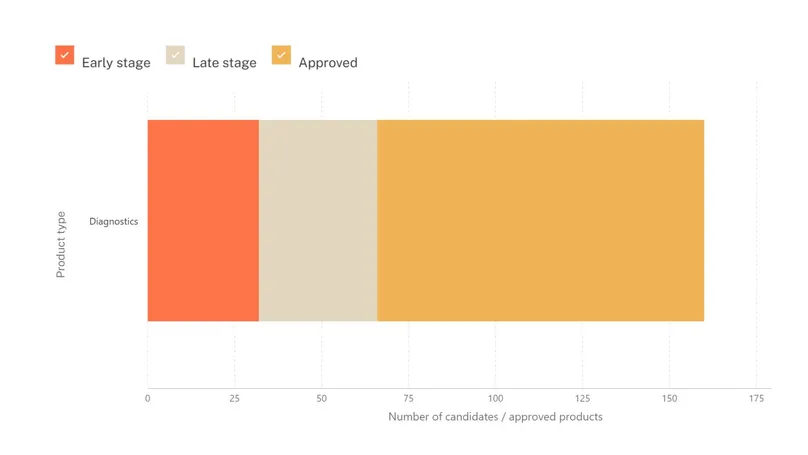
94 TB diagnostics are already approved for use somewhere in the world, with a further 32 in early-stage development and 34 in late-stage development — 160 products in total.
Are candidates progressing through the pipeline?
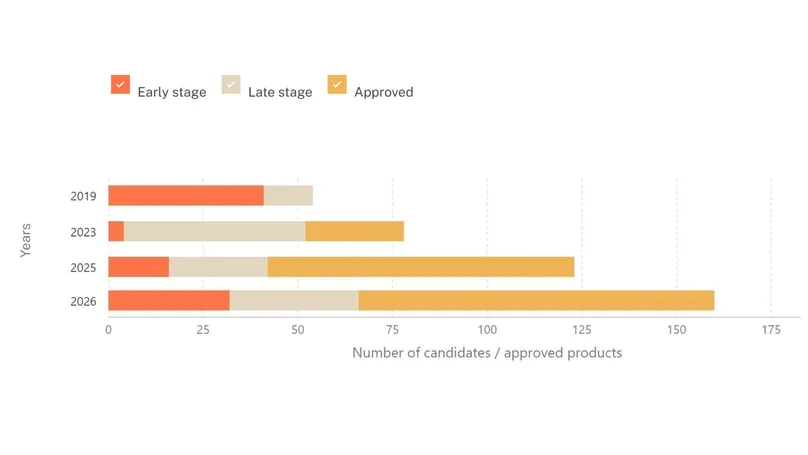
The Pipeline Trend tab tracks how the pipeline has changed across our TB diagnostics review years: 2019, 2023, 2025 and 2026.
Approved products have been tracked since 2023, and over those three review years they have risen from 26 to 94. The number of candidates in development shows no comparable trend: 54 in 2019, 52 in 2023, 42 in 2025 and 66 today.
So the growth is in products reaching the market rather than in new candidates entering the pipeline.
Figure 2: Pipeline trends (2019-2026)
What kind of tools are being developed?
In the Pipeline Explorer tab, we select 'Visual Insights' and then 'Technology types' to view the underlying methods and their R&D stage. For TB diagnostics, R&D efforts are concentrated on two technology types — molecular and immunoassay.
Figure 3: Technology types
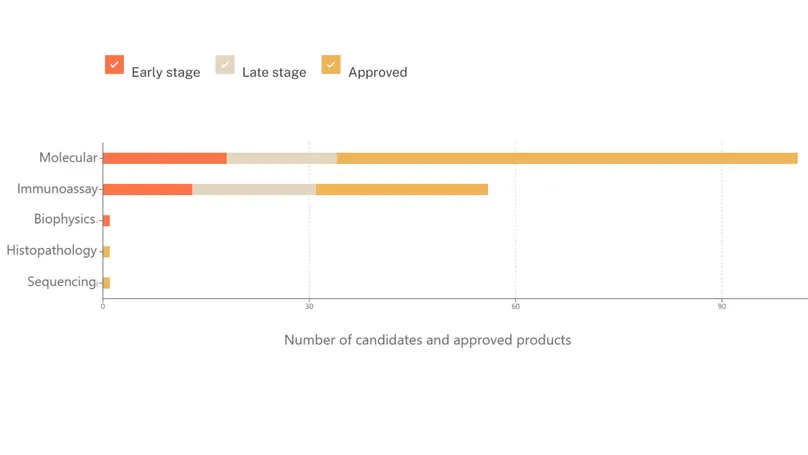
Figure 4: Technology types with molecular selected
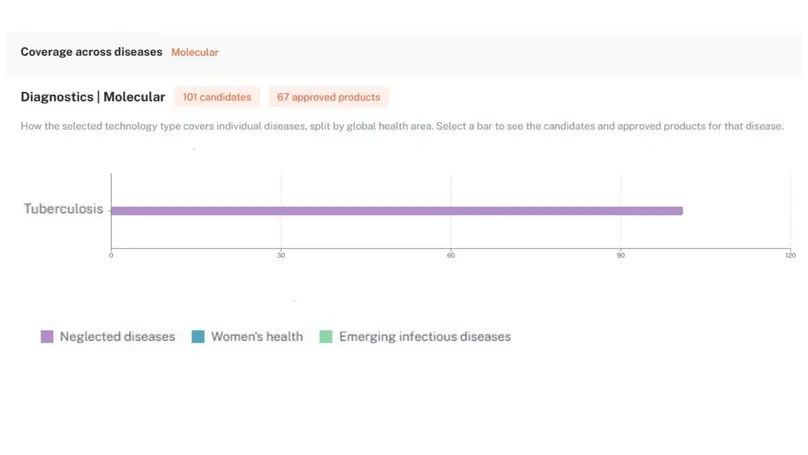
Selecting a technology type opens its coverage by disease, and selecting the disease opens the underlying records — each one carrying its test format and the health care facility level it is intended for.
Table 1: TB molecular diagnostics
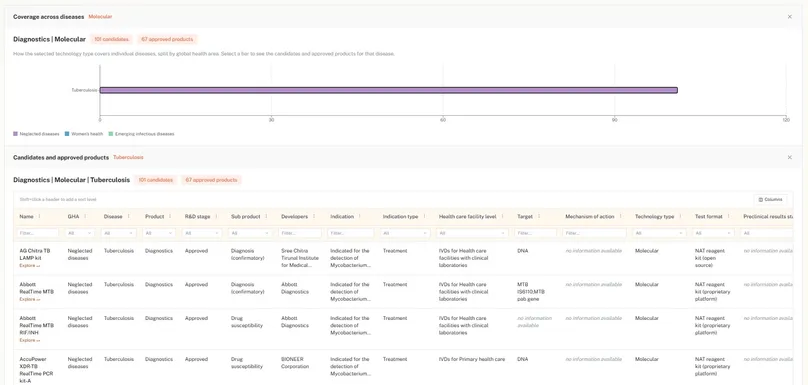
This is where the shift is visible. The proprietary-platform reagent kit, which needs a laboratory, accounts for 35 of the approved products but only 7 candidates. The pipeline has moved to cartridge-based systems and strip or cassette or rapid tests — together 45 of the 66 candidates in development, and both designed to be run outside a laboratory.
There is a catch. Cartridge systems tie a test to one manufacturer's instrument. Only 12 of the 160 products run on open platforms, and just 4 of those are in development. Decentralisation is being pursued almost entirely through closed systems.
Does the pipeline align with global needs?
By selecting the 'WHO Priority alignment' tab, we can compare the pipeline to the WHO's specifications.
Figure 5: WHO Priority alignment
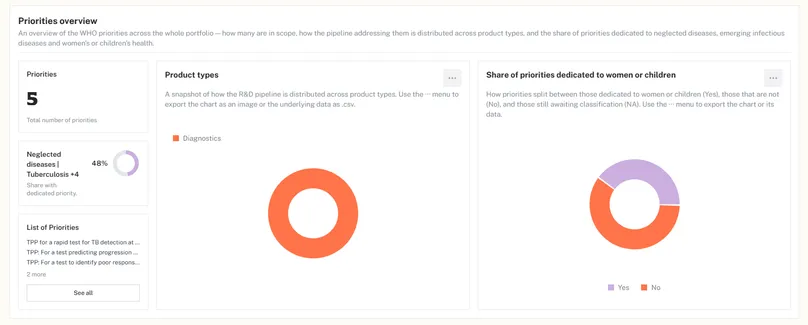
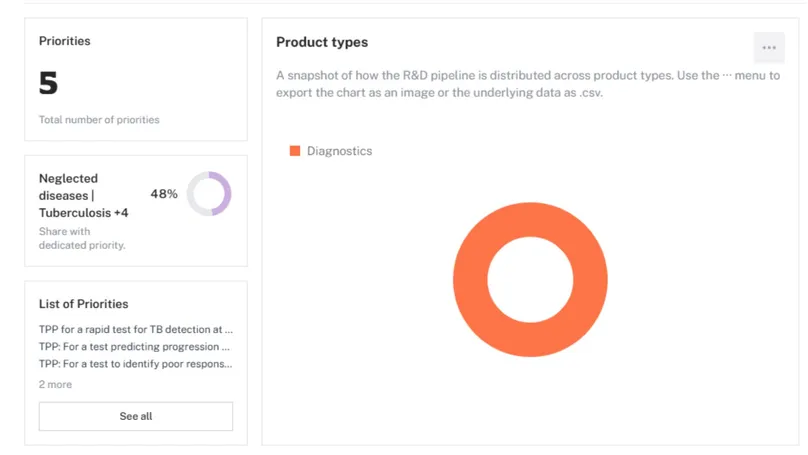
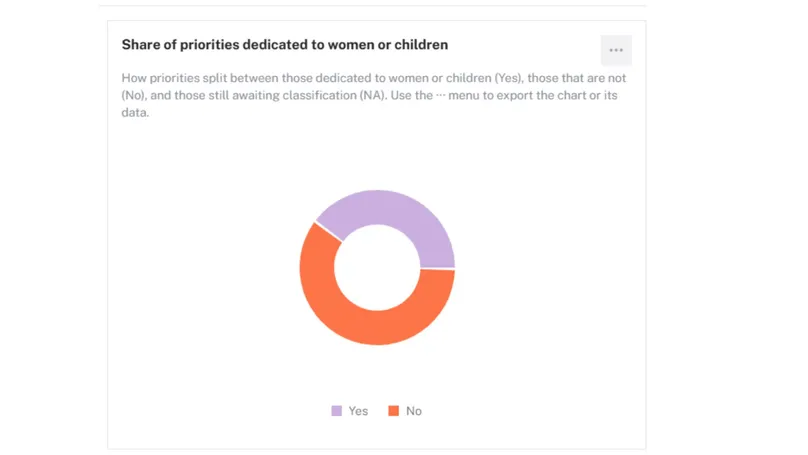
Our portal tracks the TB diagnostics pipeline against five WHO diagnostic priorities, drawn from WHO's published target product profiles.8 Mapped against them, the pipeline is heavily concentrated. Of the 66 candidates in development, 50 are working towards at least one of the five profiles — but 44 of those 50 sit against just two of them: a rapid test for detection at the peripheral level, and screening tests. The other three profiles have six candidates between them.
The size of the pipeline, in other words, says very little about whether the gaps in care are closing. For that, the priorities have to be taken one at a time.
8 Drawn from four current WHO target product profile documents for TB diagnostics: diagnosis and detection of drug resistance (2024); screening tests (2025); treatment monitoring and optimization (2023); and a test predicting progression from TB infection to active disease (2017).
Which needs are most likely to be met?
We can now dive deeper into specific target product profiles (TPP).
By selecting 'TPP for a rapid test for TB detection at the peripheral level' under the 'Individual Priority Analysis' section of the 'WHO Priority alignment' tab, we can view specific candidates.
Figure 6: Pipeline for a rapid test for TB detection at the peripheral level
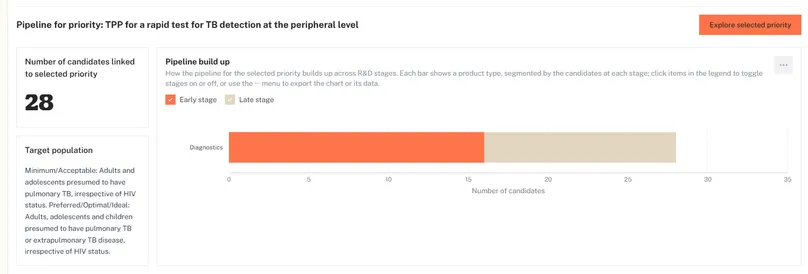
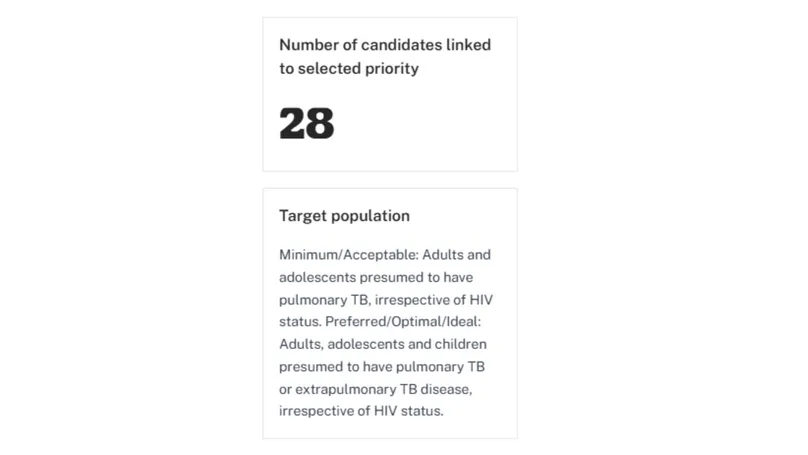
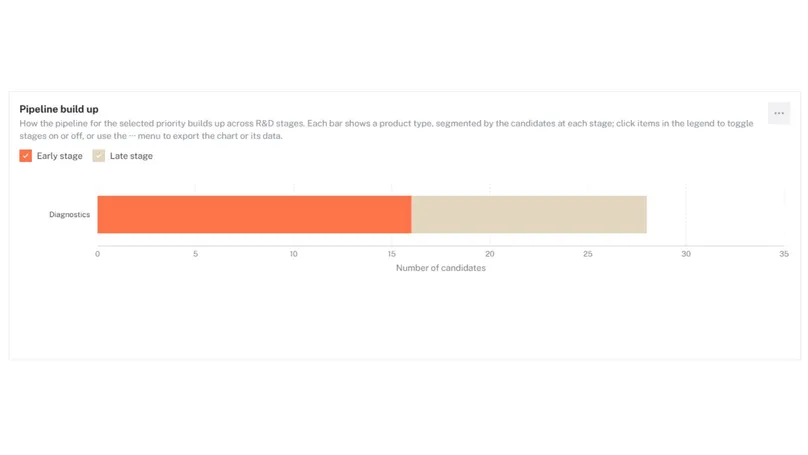
Encouragingly, the pipeline has 28 candidates across early- and late-stage development. This points to robust interest in addressing this specific need.
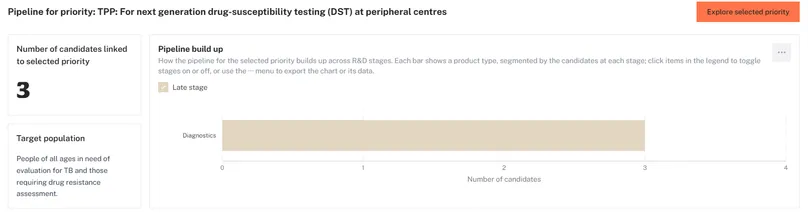
Looking at the TPP for next-generation drug-susceptibility testing (DST) at peripheral centres, the outlook is less positive.
Figure 7: Pipeline for next generation drug-susceptibility testing (DST) at peripheral centres
%20at%20peripheral%20centres%201-808x455.webp)
%20at%20peripheral%20centres%202-808x455.webp)
Despite the continuing burden of drug-resistant TB,3 only three diagnostics are in development against this profile — all three already in late stages, with nothing behind them.
For further information on the TPP, we can select 'Explore selected priority' on the right-hand side to view key information, including its intended use and target population.
Conclusion
The WHO has identified significant gaps in patient care and defined target product profiles to meet the most pressing global needs for TB diagnostics. What the portal shows is that a growing pipeline is not the same as a closing gap.
Ninety-seven of the 160 TB diagnostics in the portal are intended for primary health care, so it is not that nothing is being built for the settings that need it most. It is that the pipeline is bunched. Of the 66 candidates in development, 44 are working towards just two of WHO's five profiles. And for drug-susceptibility testing at peripheral centres — where resistance must be detected for treatment to work — three late-stage candidates carry the entire priority, with nothing behind them.
That mismatch, rather than the size of the pipeline, is what should shape where funders and developers go next. The same filters used here can be applied to any disease the portal covers.