DFMO: from sleeping sickness to treating children’s cancer
By Impact Global Health 18 June 2026
Context
Every breakthrough in global health sends ripples that reach far beyond borders. In an era of fiscal tightening and inward-facing policy priorities, investments in global health R&D are under increasing pressure. Yet these investments are among the most powerful drivers of innovation, economic growth, and resilience – not just for low- and middle-income countries (LMICs), but for high-income countries (HICs) as well. In the Ripple Effect project 1.0, Impact Global Health demonstrated that $71 billion in global health R&D funding from 2007-2023 catalysed $511 billion in GDP growth, 643,000 jobs, and 20,000 patents in HICs, a multiplier effect proving that global health investment drives domestic prosperity as well as global health outcomes. Building on this, the Ripple Effect 2.0 examined this dynamic through case studies of innovations initially developed for LMIC needs that later delivered measurable health and economic benefits in HICs. Now, the Ripple Effect 3.0 project extends this work by applying the same approach to five additional products, further strengthening the evidence base.
This case study focuses on the benefits of DFMO (difluoromethylornithine, also known as eflornithine). It was briefly conceived as a cancer treatment, but, after failing initial trials, it was successfully developed as a treatment for sleeping sickness in Africa, before being repurposed as a cream for unwanted facial hair and finally coming full circle as an FDA-approved treatment for paediatric neuroblastoma.
- A drug previously used to treat sleeping sickness in Africa is now saving the lives of child cancer patients in HICs. DFMO helps with the treatment of children with high-risk neuroblastoma, significantly increasing survival rates.
- If widely adopted, by 2050, DFMO could save the lives of more than 1,600 children across the UK and EU, averting almost 87,000 DALYs with a value of more than $10bn.
- The societal and economic returns are significant with over $10 billion in value from healthy years gained across both markets by 2050.
What is DFMO and how does it help to treat both sleeping sickness and cancer?
DFMO (difluoromethylornithine) is a drug which inhibits the polyamine pathway, which the body uses to fuel rapidly dividing cells. It works on African sleeping sickness by targeting the parasite’s own polyamine growth pathways, preventing it from spreading further and reducing its ability to fight off the host’s immune system. DFMO also works on cancer, and specifically neuroblastoma, a rare brain cancer which overwhelmingly affects young children. In this context, it works by starving the neuroblastoma’s cells of polyamines – the growth-supporting molecules they depend on – helping to prevent residual tumour cells from regrowing after other kinds of treatment, like chemotherapy or surgery, helping to prevent relapses.
Innovation pathway
DFMO was first briefly conceived of as a treatment for cancer, based on its potential effect on tumour’s growth. But a series of early trials conducted in the 1970s proved abortive, with severe side effects bringing them to an end before any meaningful effect on tumour size could be established.
DFMO would likely have joined the long list of ambitious but ultimately unsuccessful cancer treatments, but for a serendipitous discovery: scientists studying tropical diseases at Haskins Laboratories in New York tried using DFMO on mice deliberately infected with the trypanosome parasite which causes sleeping sickness (formally known as human African trypanosomiasis, or HAT). Clear positive effects on the parasites in mice led to studies on humans, and eventually registration as a groundbreaking treatment for sleeping sickness. Its effect on late-stage cases where patients had already fallen into a coma led to it being nicknamed the ‘resurrection drug’, but its side-effect profile and the large doses required left it superseded by newer sleeping sickness drugs and regimens.
After a brief period as a hair removal cream – its cell growth-retardant properties harnessed against hair follicles on users’ upper lips – scientists finally found a revised use for DFMO in fighting cancer. By using DFMO to prevent tumour regrowth, rather than as a first-line treatment intended to shrink them, clinicians were able to use much lower doses, avoiding the worst of the side effects which had scuttled progress in the 1970s.
A 2020 study of DFMO for neuroblastoma comparing 90 DFMO patients to 270 non-DFMO controls found that 4-year event-free survival rose by 11 percentage points (to 84%) with DFMO and 4-year overall survival by 12 percentage points (to 96%). This led to its approval by the FDA for the treatment of childhood neuroblastoma.
Health impact in the EU and UK
We modelled the potential impact between 2025 and 2050 from the adoption of DFMO for responsive cases of high-risk neuroblastoma across the EU and UK – key HIC markets selected in this study for their substantial impact and good data availability. Based on the increased rates of 4-year overall survival used by the FDA in approving DFMO in the US, we projected an additional 1,620 survivors – or averted deaths – across 13,500 cases of responsive high-risk neuroblastoma, almost all of them in patients under five years of age.
Table 1: Potential health impact from DFMO in the EU and UK
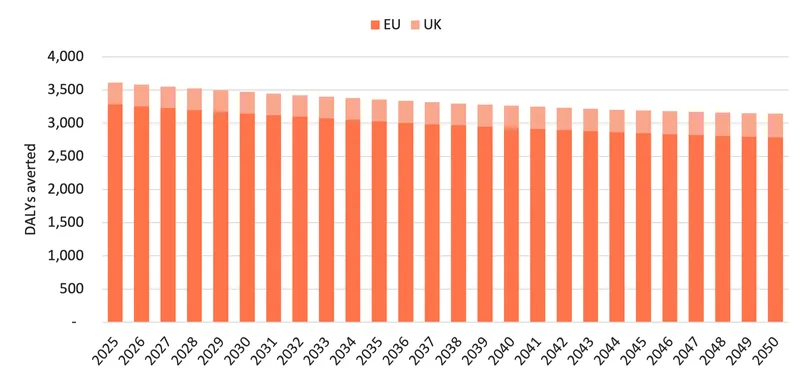
The young age of the beneficiaries of DFMO means that each death averted leads to a large number of years of life saved, captured in our estimate of DALYs averted. We estimate a total of 78k DALYs averted across the EU, and a further 8.7k in the UK, for a grand total of 87k DALYS averted between them. The chart below shows the annual distribution of the averted DALYs for the UK and the EU. Their gradual decline reflects a slight downward trend in neuroblastoma cases over time as a result of the declining fertility present in recent demographic trend data and incorporated into our model of the future child population.
Figure 1: Potential DALYs averted by DFMO in EU and UK
Economic Impact in the EU and UK
Being alive and in good health has a value to the individual and to society. Using the Value of a Statistical Life approach, we estimated the value of societal gains from 87k DALYs averted – discounted to reflect the slightly lower value associated with future years lived – to be just over $10bn[1] across our two markets.
Table 2: Value of potential impact from DFMO in the EU and UK
Figure 2: Value of potential health gains from DFMO in EU and UK
-808x497.webp)
The slightly steeper downward trend here reflects both the decline in fertility captured above and the effect of discounting future life years at 2%, so that lives saved in 2050, leading to children who would otherwise have died from cancer living past 2100, are treated as less valuable than lives saved today. This reflects, in part, the radical uncertainty associated with valuing life in the distant future – other treatments, for example, may have made DFMO unnecessary by 2050.
[1] For ease of comparison, all monetary values are reported in inflation-adjusted 2025 US dollars
Conclusions
DFMO illustrates how valuable treatments can emerge through non-linear development pathways, especially when neglected disease research keeps promising science in active use. Initially explored as a cancer therapy, DFMO might have been abandoned after early trials proved abortive. Instead, its repurposing for sleeping sickness created the scientific, clinical and product-development foundation that later enabled its return to oncology.
Its eventual approval for paediatric neuroblastoma shows the wider value of sustaining research ecosystems around neglected diseases. In this case, work originally redirected towards an African sleeping sickness indication helped preserve and refine a drug that is now projected to save more than 1,600 children across the UK and EU by 2050, averting around 87,000 DALYs and generating more than $10 billion in societal value.
Because neuroblastoma is rare, DFMO’s aggregate impact is smaller than some other products in this series. But for the children who benefit, and for their families, the effect is profound. DFMO reinforces a core lesson of the Ripple Effect: global health R&D can preserve scientific options, create unexpected second uses, and deliver measurable health and economic value well beyond the populations it was originally repurposed to serve.