A choice for all?
By Emily Smith 24 September 2026
What seven years of contraceptive, MPT and abortion R&D funding says about agency, intention and access
This year’s World Contraception Day is a chance to hold up a mirror to the sector, and the reflection is mixed.
Women’s health research has a well-documented funding problem. With 78 million women across LMICs wanting to avoid pregnancy but not using contraception, and unmet need disproportionately concentrated in Sub-Saharan Africa, R&D funding isn’t keeping up. Even as non-hormonal and user-controlled options make headlines, the funding underneath tells a more complicated story – concentrated among a handful of funders and often bottlenecked at early stages of R&D.
This year’s World Contraception Day is a fair prompt to check the R&D data against the ambition of agency, intention and access.
Introduction
Contraception, MPT and abortion funding, 2018-2024
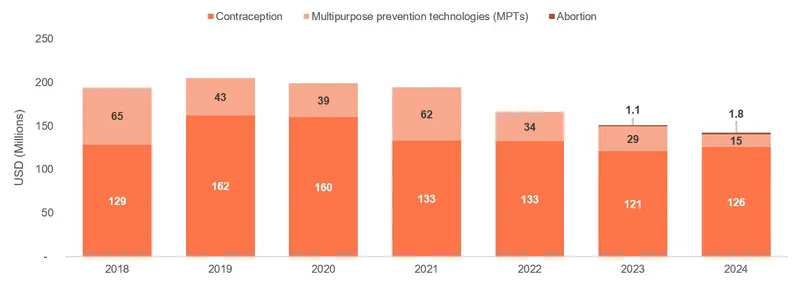
Since 2018, Impact Global Health has tracked global R&D funding for contraception, multipurpose prevention technologies (MPTs) and abortion, among other conditions primarily affecting women in our Women’s Health Hub.

Seven years in, the headline number is declining: contraception funding peaked at $162m in 2019 and has since fallen to $126m in 2024; MPT funding has fallen even further, down almost 80% since 2018 to just $15m; and abortion R&D funding, which we’ve been collecting since 2023, barely exists as a funded field, at under $2m a year. Within that shrinking pool, though, there are shifts that are reshaping the landscape.
Agency
Users are gaining more control
Contraception (left) and MPT (right) funding, by administration
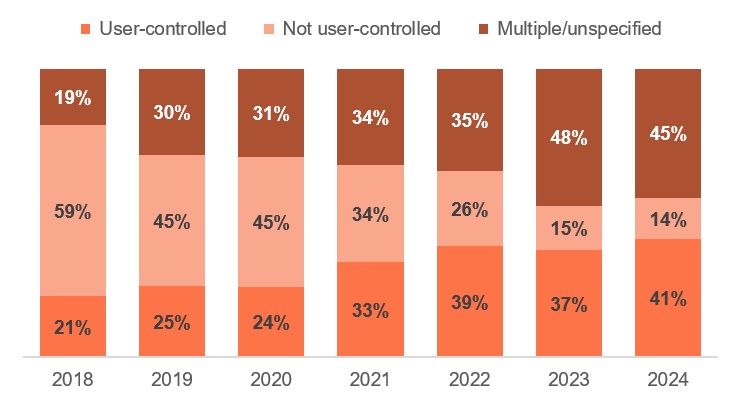
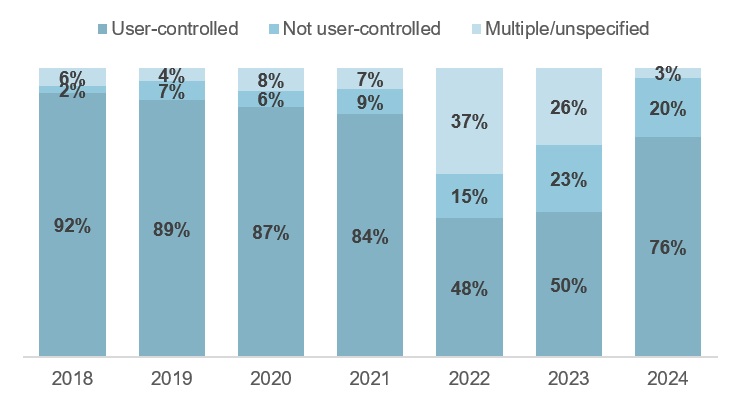
One of the clearest trends in the data is a shift toward user-controlled methods. Funding for user-controlled methods has doubled its share of the contraceptive total, from 21% ($27m) in 2018 to 41% ($52m) in 2024, while funding for non-user-controlled methods has plummeted from $77m in 2018 to $18m in 2024.
That is agency in its purest form: people managing their own contraception.
Contraception funding by duration of method
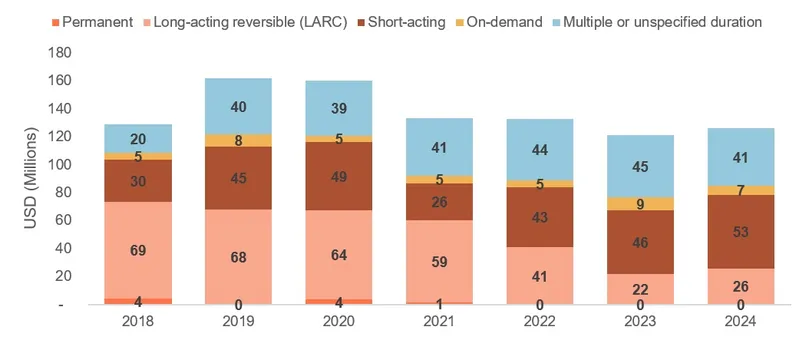
Simultaneously, as user-controlled R&D funding has increased, funding for long-acting reversible contraception (LARC) has been declining over time with short-acting options for the first time taking the largest proportion of funding in 2024 at 42% ($53m) - the majority being for drugs. This shift does not necessarily reflect more investment into new, novel short-term methods – although that’s not to say there have not been any – but reflects momentum into building upon current methods, for example injectables that are effective for six or twelve months rather than the current one-to-three-month options.
LARC funding fell by almost two-thirds, from $69m in 2018 to $26m in 2024, mostly for devices and combination products. Permanent and on-demand methods, meanwhile, have barely registered at all – a gap that has persisted across all seven years. Real agency would mean choice across the whole method mix – not just within a few method types.
Contraception (left) and MPT (right) funding, by end user
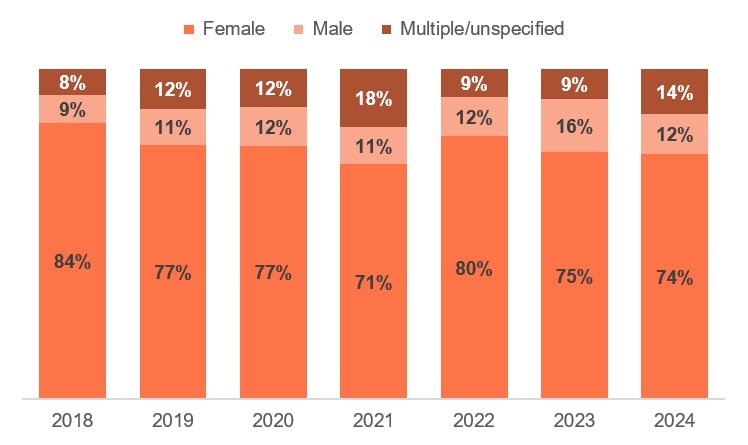
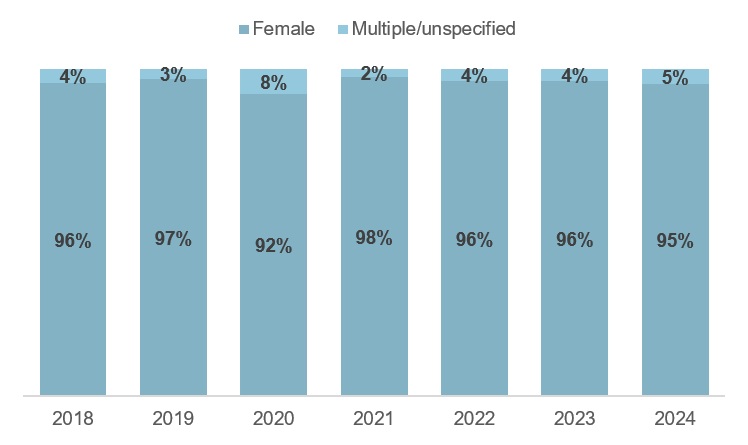
That progress has so far also been overwhelmingly a story about women, who have commanded three-quarters to five-sixths of contraception funding throughout (74% in 2024) and over 90% of MPT funding every year without exception.
Funding directed at men has crept up, from 9% of the total in 2018 to a high of 16% in 2023 before easing to 12% in 2024 due to the conclusion of multiple grants from the Male Contraceptive Initiative and US NIH. While new male focussed products are often teased in the media, the vast majority of grants remain in early development with no product yet to reach the final stage of clinical development. Extending agency and choice to men in the world of contraception, is yet to fully materialise.
Intention
A pipeline still weighted toward the earliest stages
Contraception funding, by R&D stage
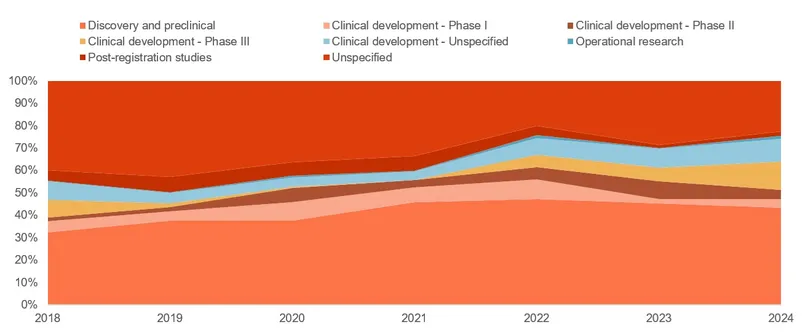
If agency asks what gets developed, intention asks how far funders are prepared to carry it.
Discovery and preclinical research absorbed 43% of contraception R&D funding in 2024, up from 32% in 2018, while the entire clinical pathway – Phase I through III and unspecified clinical stages combined – reached just 31%, with Phase III trials alone at 12.5%, a figure that was close to zero as recently as 2021. Contraceptive innovation has yet to mature, reflected by 20–45% of contraception funding going to methods of 'multiple or unspecified' duration – often non-hormonal or male-directed candidates that haven't yet reached the stage where a duration of action is even defined. Part of the explanation may lie in who is funding this work.
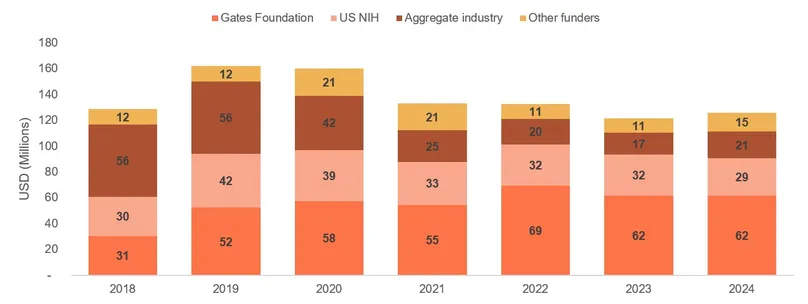
From 2018 to 2024, close to 90% of contraception R&D funding has come from just three sources – the Gates Foundation, the US National Institutes of Health (NIH) and industry – with the balance shifting substantially: Gates funding roughly doubled from 2018 to 2024 ($31m to $62m) while industry funding fell by almost two-thirds ($56m to $21m) and has been the main driver behind the total funding decline.

The reduction in industry funding reflects a shift away from heavy investment in preclinical to phase III development of LARCs between 2018 and 2020 to more modest investment in short term methods between 2022 to 2024. A pipeline this dependent on a handful of funders is vulnerable – we’ve already seen this happening in 2025, when combined Gates and NIH funding fell 17% compared to 2024 and USAID funding, once $18m, dropped to zero. This concentration means intention is only ever as durable as the willingness of a handful of institutions to keep funding through the costliest, riskiest stages of development – exactly where the pipeline is currently thinnest.
Contraception funding, by funders
MPT funding, by funders
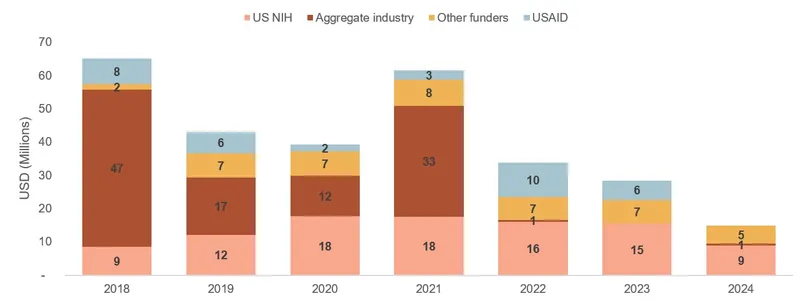
The same concentration shows up more starkly elsewhere.
MPT funding is dominated by a rotating handful of funders, two of whom have largely withdrawn: industry funding collapsed from $47m in 2018 to under $1m in 2024, and USAID funding, which peaked at $10m in 2022, fell to zero from 2024.
Abortion R&D funding is smaller still – only Grand Challenges Canada and industry reported any investment in 2023 or 2024, together under $2m a year and almost entirely without a specified R&D stage.
Access
Closing a market gap
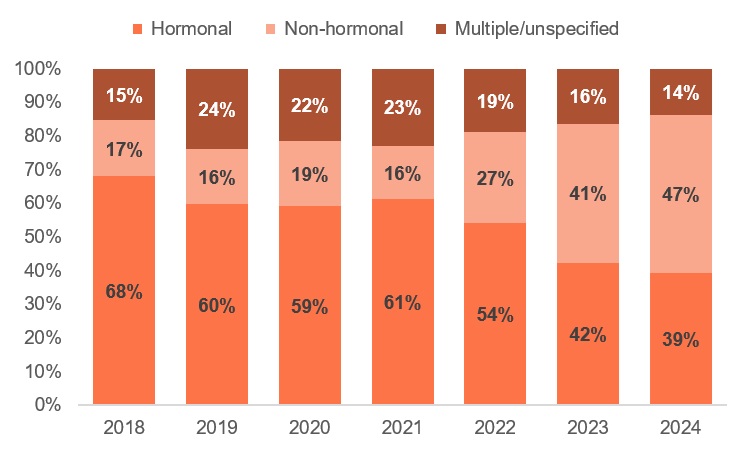
Non-hormonal contraception is the access story that mirrors agency – funding following what people want rather than what is already available. Non-hormonal method funding has almost tripled its share of the total, from 17% in 2018 to 49% in 2024, overtaking hormonal funding (41%) for the first time in the dataset.
Access, in this context, is about expanding the range of options available to those whose needs are not met by hormonal contraception. Neither category is free of side effects, and the point is not that one is better than the other: it is that the hormonal methods currently available don't meet every person’s needs, and those needs change across a reproductive lifetime.
Demand for simpler, less systemic approaches with fewer or different side effect profiles is being driven by women wanting a method that suits them at a given point in their lives. Seen that way, the shift could indicate R&D beginning to respond to demand the existing method mix has never fully met.
Contraception (left) and MPT (right) funding, by hormone profile
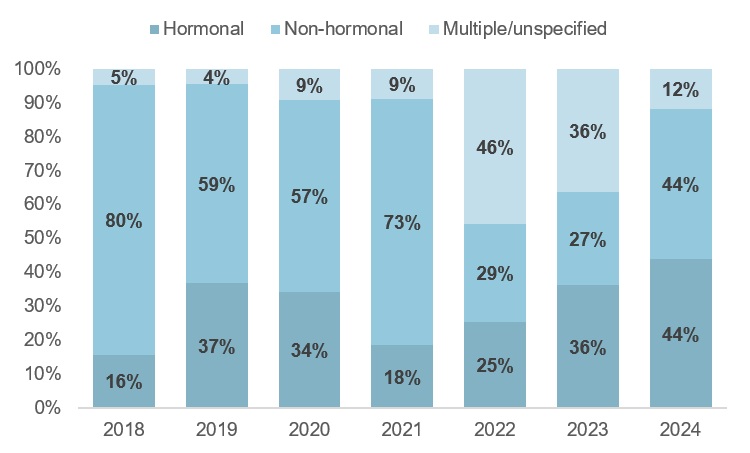
MPTs tell a related but different story: an almost entirely non-hormonal field in 2018 (80% of funding, reflecting products like diaphragms and microbicides) has shifted toward hormonal-inclusive combination products – 44% by 2024. This does not reflect more absolute R&D funding for hormonal MPTs, but an 87% decrease in total funding for non-hormonal MPTs from $52m in 2018 to just $6.6m in 2024.
Takeaway
This year's World Contraception Day offers a chance to hold up a scorecard for where the R&D funding data actually lands against three pillars of contraceptive choice - agency, intention and access.
- Agency is visibly improving, with funding shifting toward user-controlled methods even as men remain largely left behind.
- Access is following a similar arc, with growth in non-hormonal options expanding the available method mix.
- Intention lags furthest behind: funding is concentrated among a handful of funders and stuck at early discovery, leaving the costliest, riskiest stages of development chronically under-resourced.
Our hope is that reading this data through the lens of agency, intention and access, pushes funders and developers to ask not just how much is being invested, but in what, how far, and for whom.